
RegionThessaly & PieriaMytikas peak ≈ 40.09° N, 22.36° E
Othrys and Olympus: the Titanomachy across the Thessalian Plain
Two mountain ranges, a hundred kilometres of plain, and ten years of war: the oldest battle in Greek myth has a map reference.
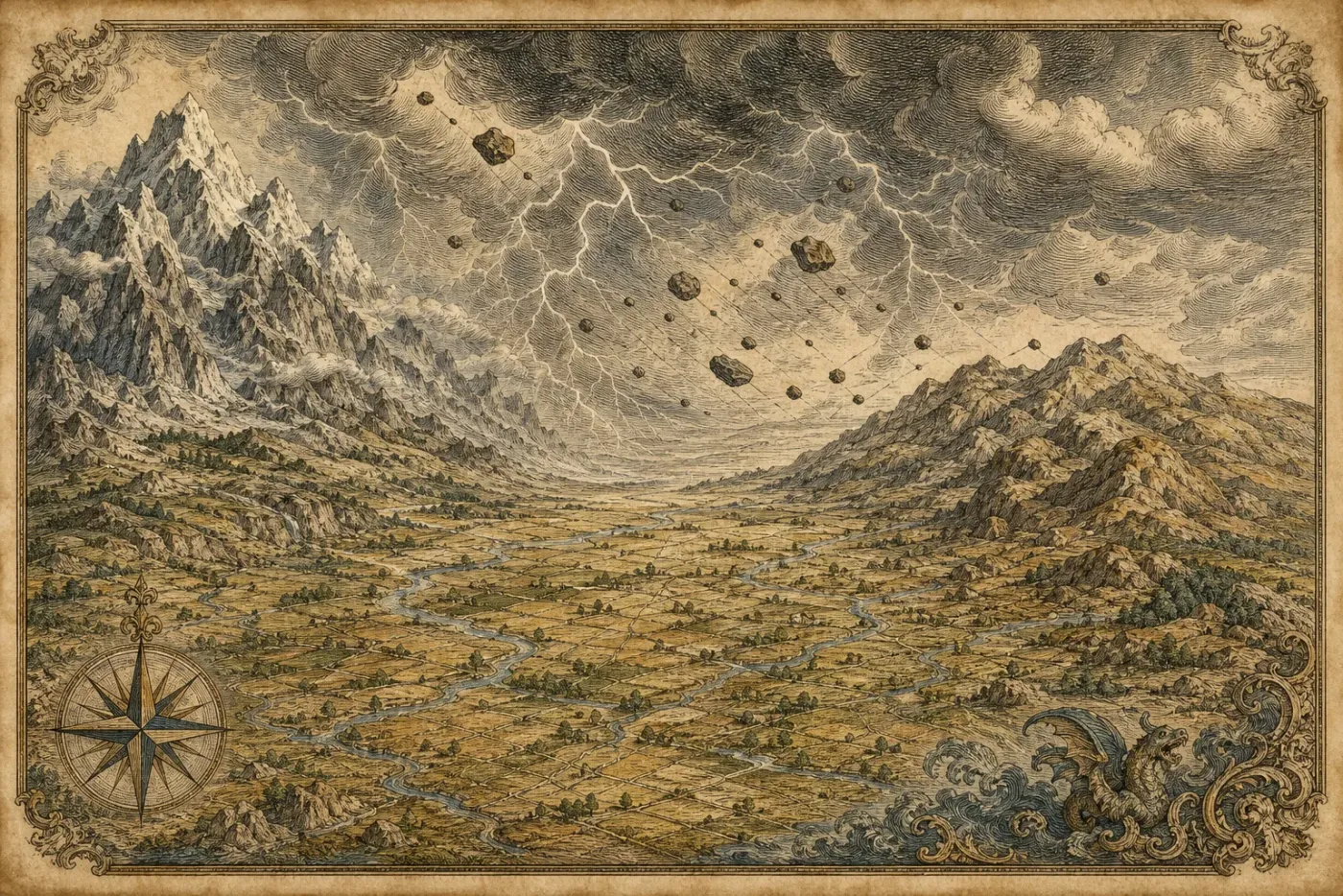
Most wars in Greek myth have a city at their centre. The first one has a landscape. When Hesiod describes the struggle between the Titans and the younger gods in his Theogony, he gives each side a mountain: the Titans fought from Othrys, and Zeus and his brothers and sisters from Olympus. Both are real, both can be found on a road map of Thessaly, and the broad farming plain between them is the stage on which the old order of the world was overturned.
The place Two mountains and a plain
Mount Olympus rises on the border of Thessaly and Pieria, close enough to the Thermaic Gulf that sailors use it as a landmark. Its highest summit, Mytikas, reaches roughly 2,900 metres, which makes it the tallest mountain in Greece. For much of the year its upper ridges hold snow, and on many days cloud sits on the peaks while the coast below is in sunshine.
Othrys is a very different mountain. It lies on the southern rim of the Thessalian plain, more than a hundred kilometres from Olympus, and it is lower, rounder and greener, a range of oak and fir forest rather than bare limestone. Between the two stretches one of the largest plains in Greece, drained by the Pineios river, a country of wheat and cotton fields that still looks, from a high viewpoint, like the open arena Hesiod needed.
Geography gives the myth its logic. The older generation holds the lesser height on the south side; the newcomers hold the greater one to the north. When the war ends, the winners stay on the higher mountain for good, and Olympus becomes the name of the gods' home in every story that follows.
The myth Ten years of war
The quarrel was a family one. Cronus, leader of the Titans, had swallowed his children as they were born, fearing that one of them would overthrow him; the youngest, Zeus, was saved by a trick and grew up in hiding on Crete (we follow that part of the story on our Crete sheet). Once grown, Zeus forced his father to bring up the swallowed children, and the brothers and sisters together took up arms against the Titans.
Hesiod says the fighting went on for ten full years without either side gaining the upper hand. What broke the deadlock was an alliance with prisoners. Zeus freed the three Hundred-Handed giants, Cottus, Briareos and Gyges, whom their father Uranus had shut away beneath the earth, and revived them with nectar and ambrosia. In return they joined the battle, hurling rocks in volleys of hundreds at a time. The Cyclopes, also released, gave Zeus the thunder and lightning that became his weapons.
The battle scene in the Theogony is one of the loudest passages in early Greek poetry. The sea roars, the earth crashes, the sky groans, and Olympus shakes from its base. Zeus throws bolt after bolt until the forests burn and the air is full of heat, and the Titans, buried under rocks, are finally beaten and bound. They are sent down to Tartarus, which Hesiod places as far below the earth as the sky is above it: a bronze anvil dropped from the earth, he says, would fall for nine days and nights before reaching it. The Hundred-Handers stand guard at its gates.
On the ground Reading the landscape
Thessaly was a place where the ancient Greeks liked to explain the land through stories. Herodotus reports that the plain was once said to be a lake, until Poseidon split the mountains and let the water out through the Vale of Tempe, the narrow gorge between Olympus and its neighbour Ossa. Stand in the gorge, with the river squeezed between cliffs, and a god seems the likeliest engineer.
The same corner of the map holds another story that is easy to confuse with the Titanomachy. In the Odyssey, the giant twins Otus and Ephialtes plan to pile Ossa on Olympus and Pelion on Ossa so that they can climb to the sky. It is a separate rebellion, and so is the war against the Giants, the Gigantomachy, which most writers place at Phlegra, far to the north-east. The mountains of Thessaly simply attracted tales of attacks on heaven.
Sources Where the versions differ
Hesiod is our fullest early account, but he was not the only poet to tell it. An epic called the Titanomachy, attributed by ancient writers to Eumelus of Corinth or to Arctinus of Miletus, existed in antiquity and survives only in scraps. Later mythographers such as Apollodorus add details Hesiod leaves out: the Cyclopes forge a helmet of invisibility for Hades and a trident for Poseidon as well as Zeus's thunderbolt, and an oracle of Earth promises Zeus victory if he enlists the prisoners of Tartarus.
Writers also disagree about where Cronus ended up. Hesiod sends him to Tartarus with the other Titans; other traditions, including passages in Pindar, let him rule over the Islands of the Blessed at the edge of the world. And one Titan was not imprisoned at all but given a job instead: Atlas, who holds up the sky. His story has its own pin at Olympia.
For the traveller the lesson is simple. Stand anywhere on the plain of Thessaly on a clear day and you can see the problem the Titans faced. The mountain to the north is higher, and it is usually wearing a cloud.