
RegionCretePsychro cave ≈ 35.16° N, 25.45° E
Crete: the Mountain Caves Where Cronus Was Tricked
A Titan who ate his children, a stone in a blanket, and a baby god hidden underground. Crete claims the cave, and has two candidates.
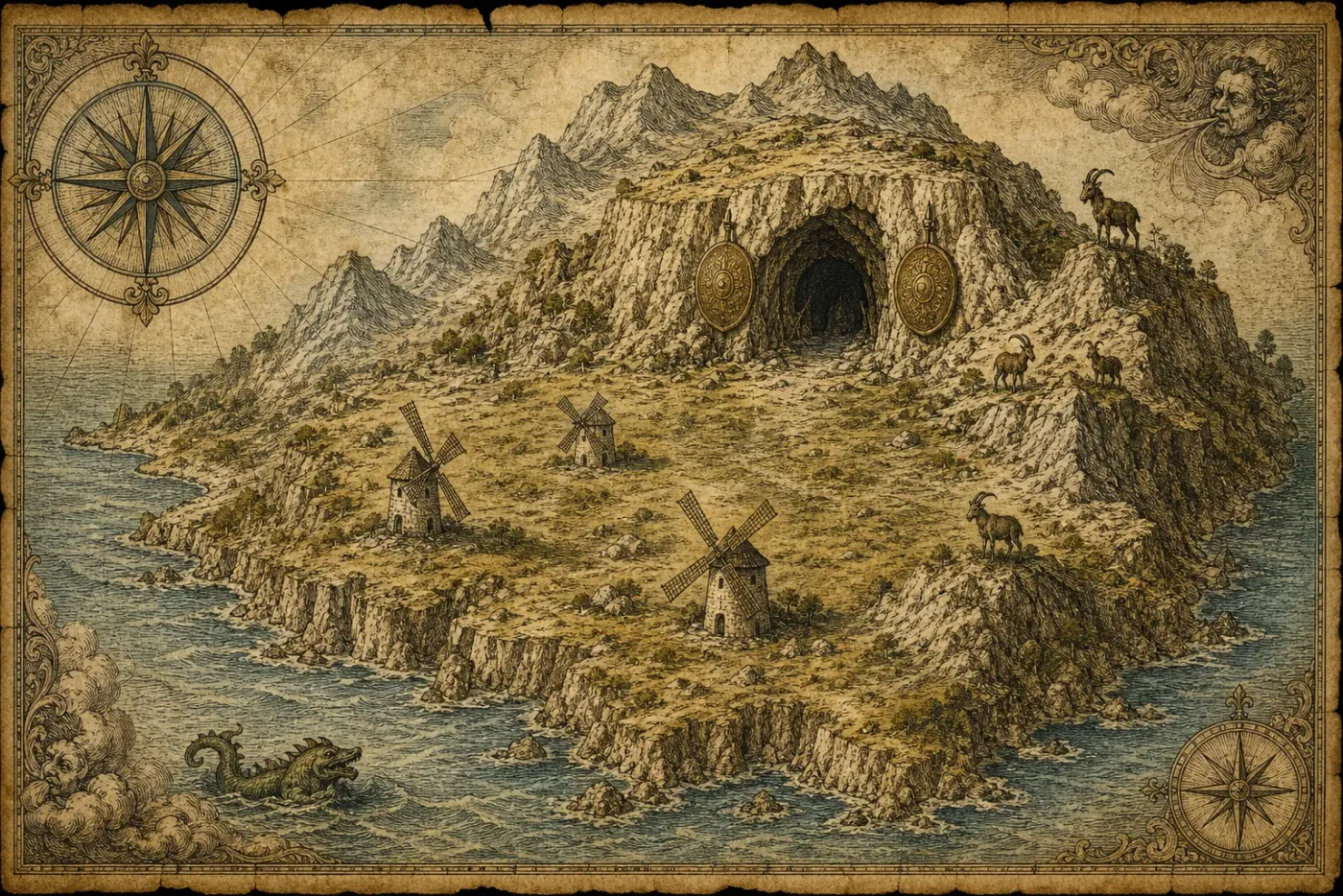
Cronus is the villain of the second generation of Greek gods, and his story is one of the strangest in the whole mythology. It is also one of the most firmly located. The mainland supplied the battlefield where his rule ended, but the decisive move, the one that made his defeat possible, was made on Crete, in a cave high in the mountains.
The myth The father who swallowed his children
Cronus was the youngest of the Titans, the children of Earth and Sky. He took power by attacking his father Uranus, a story we tell at its own pin, Delphi. Having overthrown a father, he feared the same fate. His parents warned him that he was destined to be defeated by one of his own sons, so as each of his children by his sister Rhea was born, he swallowed it. Hestia, Demeter, Hera, Hades and Poseidon all disappeared this way.
When Rhea was about to give birth to her last child, she went to her parents for help. In Hesiod's version they sent her to Lyctus, in Crete, where Earth received the newborn Zeus and hid him in a cave on a wooded mountain. Rhea then wrapped a large stone in swaddling clothes and handed it to Cronus, who swallowed it without looking.
Later writers fill in the nursery. Apollodorus says Zeus was born in a cave on Mount Dikte and looked after by nymphs, who fed him on the milk of the goat Amalthea. Armed young men called the Kouretes guarded the entrance, clashing their spears against their shields so that Cronus would not hear the baby cry. When Zeus was grown, Cronus was made to bring up the stone and then the swallowed children, who were now adults and ready to fight. In Apollodorus the emetic is a drug supplied by Metis; Hesiod credits the cunning of Earth.
The place Two caves, one claim
Hesiod names Mount Aegaeum, a peak no one has been able to identify with certainty. Later sources point to two real mountains, and both have caves that were busy sanctuaries in antiquity.
The first is the Dictaean Cave above the village of Psychro, on the edge of the Lasithi Plateau in eastern Crete. The plateau is a high, flat bowl surrounded by the Dikti range, famous in more recent centuries for the windmills that once pumped water for its orchards and fields. The cave itself opens on a hillside above the plain and descends steeply into a cavern hung with stalactites. Excavations around 1900 found large numbers of offerings left there over many centuries, including bronze figurines, weapons and double axes.
The second is the Idaean Cave on Mount Ida, which Cretans today usually call Psiloritis, the island's highest mountain. It lies near the Nida Plateau, well above the treeline in summer pasture. Its most famous finds are decorated bronze shields of the early first millennium BC, which many scholars connect with the Kouretes and their clashing shields. Ancient writers do not agree which cave was the birthplace, and some tried to reconcile the two by making one the place of birth and the other the place where the child was raised.
Afterlives A god who was born and died here
Crete's attachment to Zeus went further than the birth. Some Cretans also pointed to a tomb of Zeus on their island, a claim that scandalised other Greeks, since gods do not die. The poet Callimachus, in his hymn to Zeus, repeats the old saying that Cretans are always liars and gives the tomb as the proof. The story suggests that the Cretan Zeus was originally rather different from the Olympian king: perhaps a god of the yearly cycle of growth, born and reborn.
The stone that Cronus swallowed has its own afterlife. Hesiod says Zeus set it up at Pytho, the old name of Delphi, as a sign and a marvel for mortals, and centuries later the travel writer Pausanias saw a small stone there that was anointed with oil every day and said to be that very one. The trail therefore runs from a Cretan cave to the navel of the Greek world.
Sources Golden age or prison?
Cronus is remembered in two opposite ways. In the Theogony he is a tyrant, finally imprisoned in Tartarus. Yet in Hesiod's other poem, Works and Days, the age when Cronus ruled is the golden age, when people lived without toil or old age. The Romans identified him with Saturn and celebrated the Saturnalia, a winter festival of feasting and role reversal, in memory of that lost good time. Olympia, on the other side of the Greek world, had a hill named after him, the Kronion, which still rises beside the ancient stadium. Crete keeps the cave where he was outwitted.