
RegionElis, Western PeloponneseSanctuary ≈ 37.64° N, 21.63° E
Olympia and the Sky on Atlas's Shoulders
The Titan who carries the sky lives at the end of the earth. His portrait, and a trick played on him by Heracles, is at Olympia.
Atlas is a myth with an awkward address. The ancient poets put him at the far western edge of the world, where the sun sets and the garden of the Hesperides grows. No traveller could go there. Yet anyone who visits Olympia, in the green river country of the western Peloponnese, can stand in front of him, carved in marble about 2,500 years ago, still holding out the golden apples.
The myth The Titan with a job
Atlas was the son of the Titan Iapetus, which makes him a brother of Prometheus. Hesiod says that at the ends of the earth, near the clear-voiced Hesperides, he stands and holds up the wide sky on his head and tireless arms, because Zeus assigned him that lot. Later writers explain it as his punishment for siding with the Titans in the war fought across Thessaly. The Odyssey pictures him a little differently: he knows the depths of every sea and keeps the tall pillars that hold earth and sky apart. His daughter is the nymph Calypso, who keeps Odysseus on her island for seven years.
His best-known story belongs to Heracles. In Apollodorus's list, the eleventh labour was to fetch golden apples from the garden of the Hesperides. On Prometheus's advice, Heracles asked Atlas to pick them for him and took the sky on his own shoulders in the meantime. Atlas came back with the apples and, enjoying his freedom, offered to deliver them himself. Heracles agreed, but asked Atlas to hold the sky for a moment while he put a pad on his head. Atlas took it back, and Heracles picked up the apples and walked away. Other versions skip the trick and have Heracles kill the serpent guarding the tree.
The place Atlas at Olympia
Olympia was the sanctuary of Zeus where the Olympic Games were held, and its greatest building was the Temple of Zeus, finished in the second quarter of the fifth century BC. Above the porches at each end ran twelve sculpted panels, or metopes, showing the labours of Heracles. The panel with the apples shows exactly the moment of the story above. Heracles stands with the heavens on his shoulders, a cushion folded on his neck. Atlas faces him, holding out the apples. Behind Heracles, Athena quietly lifts a hand to help with the weight.
The sculpture is calm rather than dramatic, which is part of its charm. Nobody is fighting. Two strong figures and a goddess are negotiating over a load, and you can see the strain in Heracles's posture. Close by, the wooded hill of Cronus, the Kronion, rises above the stadium, a reminder that Atlas's generation once ruled here too.
From Australia Atlas's daughters in a southern sky
Atlas's family is still visible above Australia. Hesiod calls the Pleiades the daughters of Atlas, and his farming calendar used them as signposts: start the harvest when they rise before dawn, start ploughing when they set. In Greece that pattern ties the cluster to early summer and late autumn.
Here the seasons are flipped. From Melbourne, Sydney or Perth, the Pleiades are a summer sight, climbing the evening sky in the north-east through November and December. Orion, nearby, appears upside down to northern eyes, which is why so many Australians know his belt and sword as the Saucepan. The cluster is also important in the knowledge of many First Nations peoples, who have their own Seven Sisters stories and songlines. Those belong to their custodians, and we leave them for those custodians to tell.
Afterlives How a Titan became a book of maps
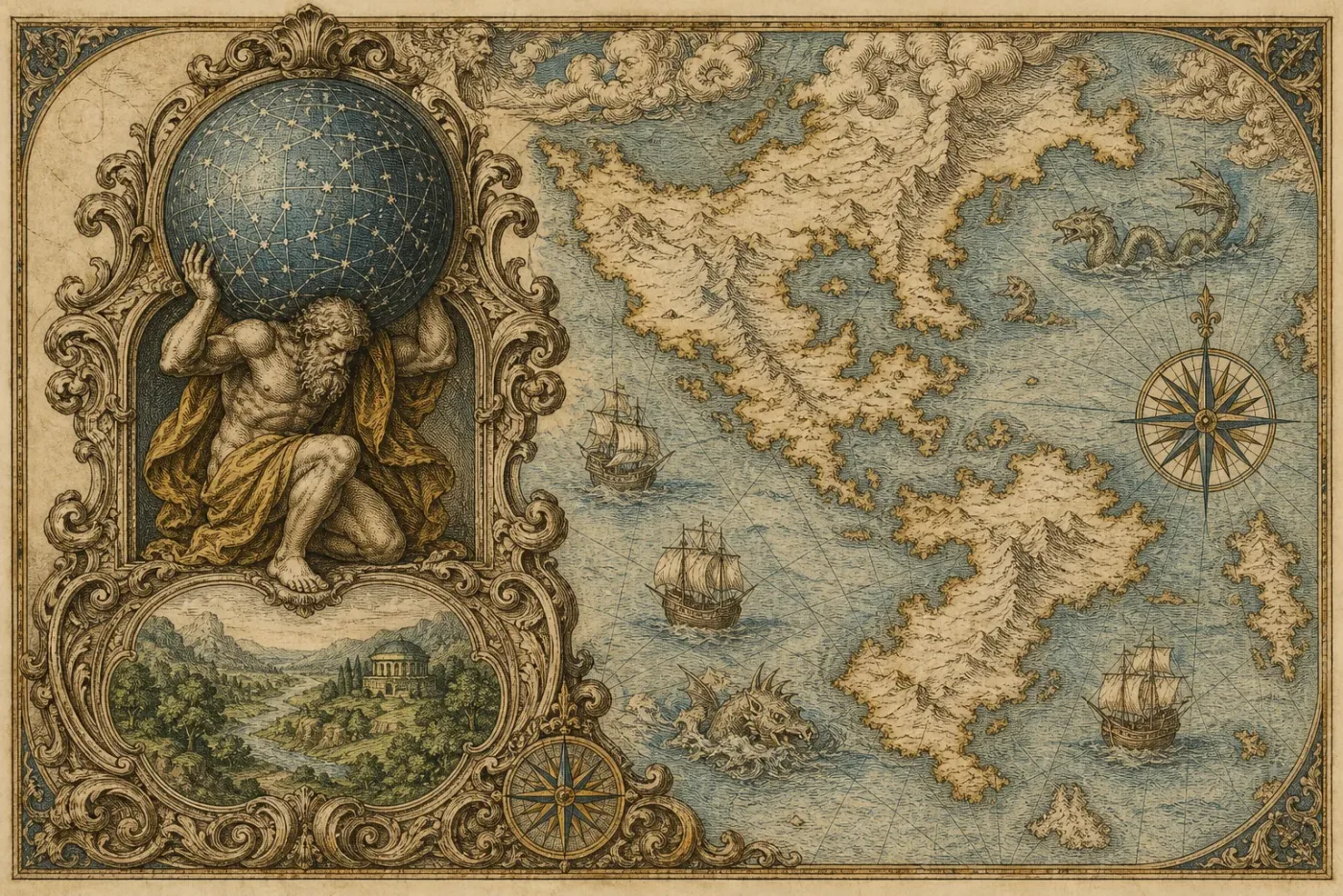
Any map site owes Atlas a debt. When Gerardus Mercator published his collection of maps in 1595, he called it an Atlas, and the name stuck for every bound volume of maps since. Mercator explained that he was honouring a legendary King Atlas of Mauretania, remembered as a learned astronomer, rather than the Titan. Engravers soon put the Titan on title pages anyway, a globe across his shoulders. The best-known ancient version of that image, the Farnese Atlas, a Roman marble now in Naples, carries a globe carved with the constellations.
Herodotus, meanwhile, gave the name to a mountain in north-west Africa, and the ocean beyond it became the Atlantic. So the Titan who stands at the edge of the world gave his name to the sea beyond that edge and to the books that later charted it.