
RegionPhocis, Central GreeceSanctuary ≈ 38.48° N, 22.50° E
Delphi, Navel of the Earth: Gaia, Uranus and the First Oracle
Earth and Sky were the first couple of Greek myth, and their quarrel shaped everything after. At Delphi, Earth kept a foothold.
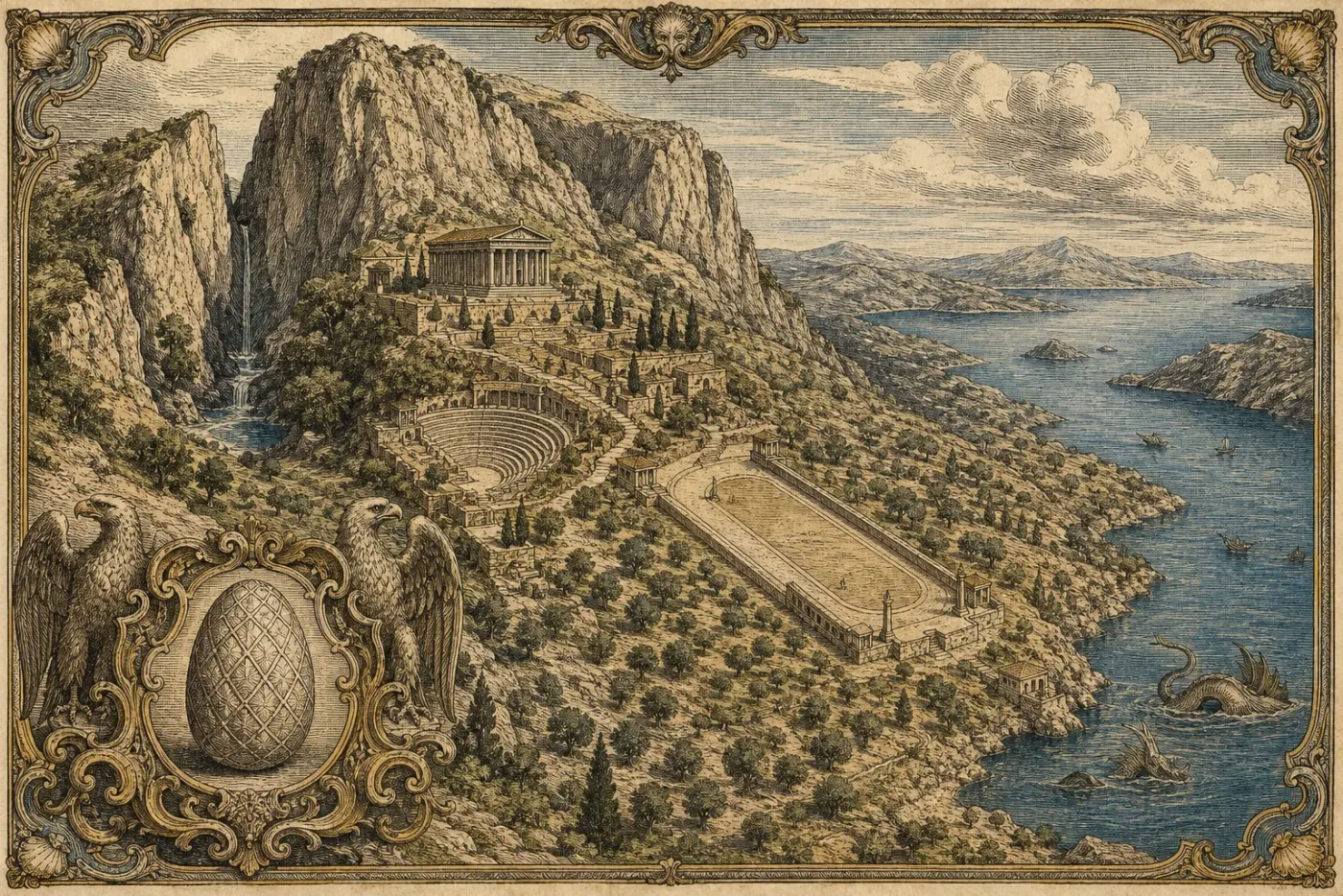
Most visitors come to Delphi for Apollo. The temple terrace, the treasuries and the theatre all belong to his sanctuary, and the oracle that made the place famous spoke in his name. But the Greeks themselves told a deeper history. Before Apollo arrived, they said, the oracle at Delphi belonged to Gaia, the Earth, the first of all the gods to take shape. To find the beginning of Greek myth on the map, this mountainside is a good place to start.
The myth Earth, Sky and the sickle
Hesiod's Theogony begins with Chaos, a yawning gap. Then came broad-breasted Gaia, the secure seat of everything that would follow. Gaia gave birth on her own to Uranus, the starry Sky, to cover her on every side, and to the mountains and the sea. With Uranus she then had the first great families of beings: the twelve Titans, the one-eyed Cyclopes and the three monstrous Hundred-Handers.
Uranus hated his children and pushed them back out of sight inside the earth, and Gaia groaned under the strain. She made a great sickle and asked her sons for help. Only the youngest Titan, Cronus, was willing. When Uranus came at night to lie with Gaia, Cronus ambushed and maimed him, separating Sky from Earth for good. From the drops of blood that fell on the earth sprang the Furies, the Giants and the ash-tree nymphs. What fell into the sea drifted on the waves until a goddess grew from the foam: Aphrodite, who came ashore first at Kythera and then on Cyprus.
It is a violent story, and it was meant to be. It explains why sky and earth are apart, why the gods of the next generation distrusted their own children, and why Earth so often appears in myth as a power to be consulted rather than defied. Gaia advises, warns and takes sides in every succession that follows, including the hiding of Zeus on Crete.
The place Why Delphi belonged to Earth
The playwright Aeschylus opens his Eumenides with the priestess of Delphi saying her prayers. She honours first Earth, the first prophet, then Themis, who took the seat from her mother, then the Titan Phoebe, who gave it as a birthday gift to Phoebus Apollo. In this peaceful version the oracle passes from goddess to god by inheritance. The Homeric Hymn to Apollo tells a rougher story, in which Apollo has to kill a great she-serpent at the spring before he can found his temple. Later writers named the serpent Python and made it the guardian of Earth's oracle.
The landscape helps explain the tradition. Delphi sits on a steep shelf on the southern flank of Mount Parnassus, under the twin cliffs called the Phaedriades, with a gorge on one side and the long valley of olives falling away to the Gulf of Corinth below. Water comes out of the rock at the Castalian spring. Ancient writers told of a cleft in the ground and a vapour that inspired the priestess; modern geologists have debated whether faults beneath the site could have released gases, and the question is still argued.
Delphi was also the centre of the world in the most literal sense. Zeus, the story went, released two eagles from the opposite ends of the earth, and they met over Delphi. The spot was marked by the omphalos, the navel stone. Hesiod adds another stone to the site: the one Cronus swallowed in place of the infant Zeus, which Zeus set up at Pytho as a wonder for mortals.
Sources Earth's other footholds
Ancient authors disagree about almost every detail of the first generations, and the differences are worth noticing. Hesiod's Aphrodite is born from the sea foam; in Homer she is simply the daughter of Zeus and Dione. Apollonius of Rhodes preserves a tradition that the sickle itself lies buried under the island where the Phaeacians lived, which most readers identify with Corfu. And the order of the prophets at Delphi changes from author to author, with Themis sometimes promoted and Phoebe sometimes left out.
What stays constant is the idea that Earth was here first. When you stand on the temple terrace and look down the valley to the sea, it is easy to imagine why the Greeks thought the ground itself might have something to say.