
RegionGreek SicilySummit ≈ 37.75° N, 14.99° E
Etna: Where Typhon Lies Buried
Off the western edge of our sheet, in the Greek cities of Sicily, a smoking mountain was the lid on the most dangerous creature Earth ever produced.
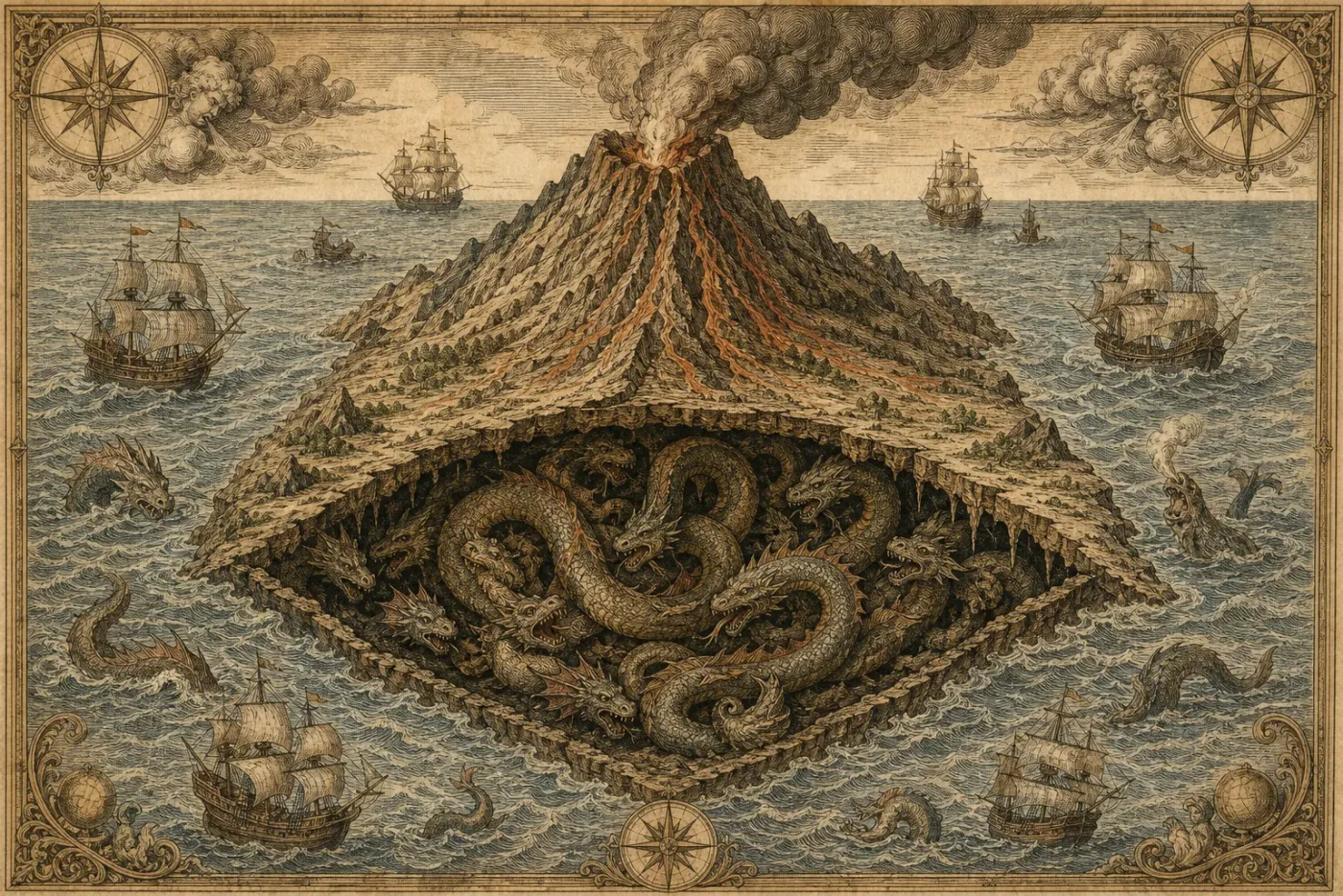
Our map of Hellas stops at the Ionian Sea, but the Greek world did not. From the eighth century BC, Greek settlers founded cities along the coasts of Sicily, and the first of them, Naxos, was built at the foot of a mountain that smoked, rumbled and sometimes poured fire down to the sea. The Sicilian Greeks knew exactly what was under it. This pin sits off the western edge of the sheet, where old cartographers would have drawn an arrow and a sea monster.
The myth Earth's last child
After the Titans were defeated and locked away, Gaia, the Earth, made one final attempt to overthrow Zeus. Hesiod says she lay with Tartarus and gave birth to Typhoeus, more often called Typhon. From his shoulders grew a hundred snake heads with flickering tongues and fiery eyes, and his voices were every sound at once: the bellow of a bull, the roar of a lion, the yelping of puppies and a hissing that echoed off the mountains.
Zeus met him with thunder. In Hesiod's battle, the earth, the sea and the sky all boil, and the land melts like tin in a smith's crucible. Zeus burns every one of the monster's heads, throws him down, and hurls him into Tartarus. From Typhoeus, Hesiod adds, come the wild, damp winds that wreck ships and spoil crops, as opposed to the useful winds born of the gods.
The route A chase across the ancient map
Apollodorus, writing much later, turns the fight into a journey, and it is the most geographical monster story in Greek myth. Typhon is born in Cilicia, on the south coast of what is now Turkey, and is so tall that his head brushes the stars. The gods flee to Egypt in terror, disguising themselves as animals. Zeus alone stands firm and fights him at Mount Kasios in Syria, but Typhon wrestles the sickle from him, cuts the sinews from his hands and feet, and hides them in the Corycian cave, guarded by a she-dragon. Hermes and the goat-god Aegipan steal them back.
Restored, Zeus chases Typhon west. At Nysa the Fates trick the monster into eating fruit that weakens him. In Thrace he hurls whole mountains, and the Haemus range, Apollodorus says, takes its name from the blood (in Greek, haima) that streamed from his wounds. Finally Typhon tries to escape across the Sicilian sea, and Zeus throws Mount Etna on top of him. The fire that still comes out of the mountain, Apollodorus says, comes from the thunderbolts that were thrown.
The place The volcano as a lid
The Sicilian version was given its most famous form by Pindar, in an ode for Hieron, the ruler of Syracuse, who had founded a new city called Aitna at the foot of the mountain around 476 BC. Pindar describes Typhon lying in Tartarus with his body stretched from Cumae, near the Bay of Naples, to Sicily, and the snowy column of Etna pressing on his chest, sending up rivers of smoke by day and red flame at night. Aeschylus uses the same image in Prometheus Bound. The Roman poet Ovid made the whole island the prison: one arm under Cape Pelorus, the other under Pachynus, his feet under Lilybaeum and his head under Etna, so that every earthquake is Typhon trying to turn over.
The picture made good sense to people living with the volcano. Eruptions came without warning, lava flows buried fields, and the earth shook. A creature that was beaten but not dead, and still struggling under the weight, was a reasonable explanation.
Sources Who is under the mountain?
Not every writer agrees that it is Typhon. In Virgil's Aeneid, the giant pinned under Etna is Enceladus, one of the Giants who fought the gods in a later war, and some Greek writers say the same. Others put Typhon somewhere else: under Ischia, near Naples, or in a marshy land in Asia Minor called Arima. Hesiod leaves him in Tartarus, with no volcano at all.
The name has travelled even further than the monster. The English word typhoon probably blends the Greek Typhon with words for a great wind from Arabic and Chinese, which carried the idea of a destructive storm across half the world. Hesiod would have approved, since for him the bad winds were Typhon's children all along.