
RegionEpirus · FolkloreDrakolimni, Tymfi ≈ 39.99° N, 20.77° E
The Dragon Lakes of Epirus: Folk Tales of the Drakos
Not a myth from the ancient poets but a living folk tradition: the drakos, a giant who guards water, and the two mountain lakes he gave his name to.
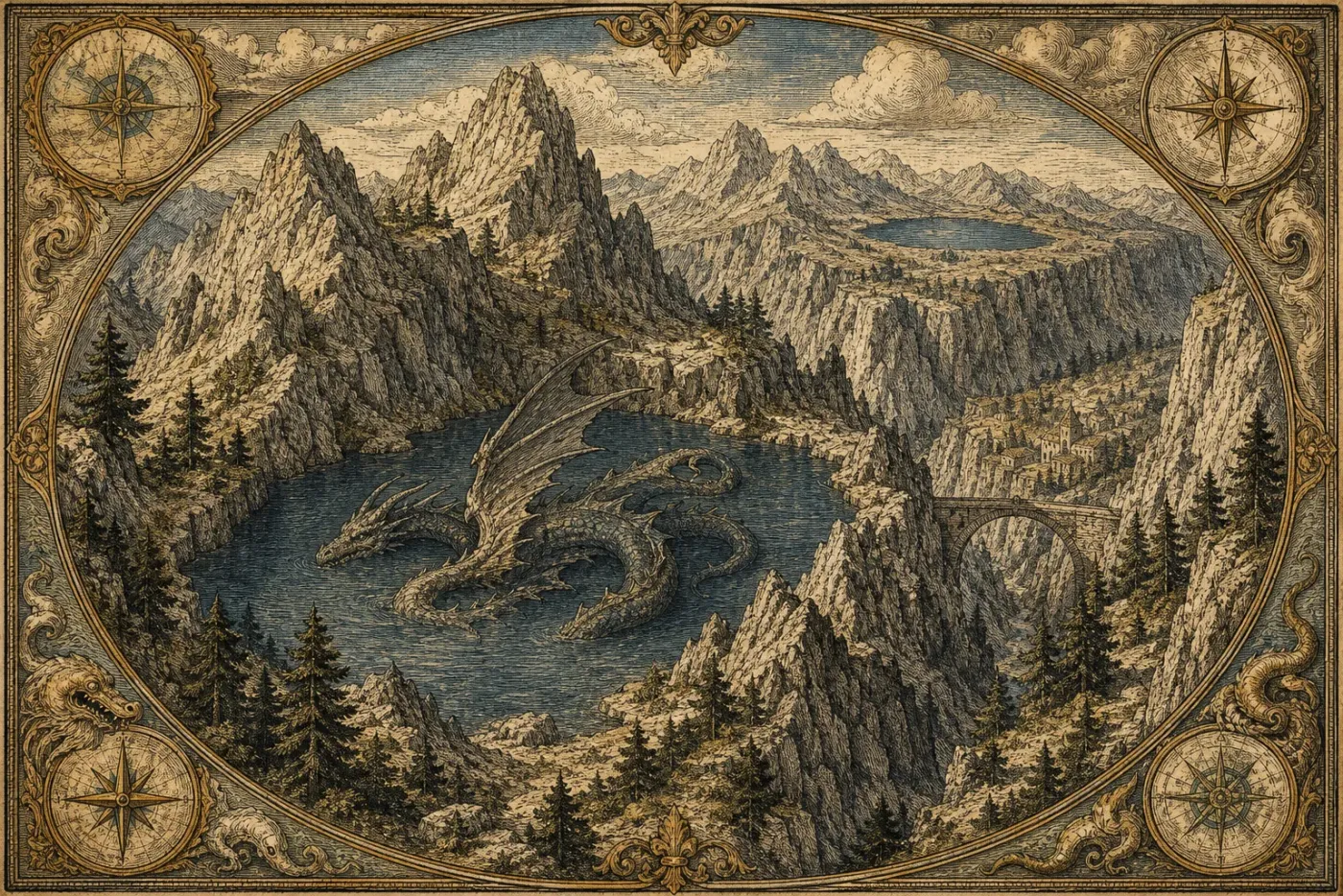
Every other pin on this map marks a story from the ancient poets. This one is different. In the mountains of Epirus, in north-western Greece, two small lakes sit just below the summits of neighbouring ranges, and both are called Drakolimni, the dragon lake. The name does not come from Hesiod or Homer. It comes from the folk tales told in Greek villages for centuries, in which the most dangerous neighbour is the drakos.
The tradition Who is the drakos?
The word looks like the ancient drakon, the great serpent that guards springs and treasures in classical myth: the Python at Delphi, the serpent of the Hesperides, the dragon of the Golden Fleece. But the drakos of Greek folk tales is usually something else. He is most often a giant, shaped roughly like a man but enormous, very strong, fond of food, and not always clever. He lives in a cave, a tower or a ruined castle, and he often has a mother or a wife, the drakaina, who can be even more dangerous than he is.
Two things about him recur across the collections of Greek folk tales gathered by folklorists such as Nikolaos Politis and R. M. Dawkins. First, he controls water. In many stories a drakos sits on the spring that feeds a village and will only let the water flow if he is given food, animals or a young woman in return. Second, he can be beaten, not by a god, but by an ordinary person, often the youngest of three brothers, a shepherd or a tailor, who wins by courage and cunning rather than strength.
The tricks are part of the fun. In one widespread tale the hero challenges the drakos to squeeze water out of a stone. The drakos crushes a rock to powder and gets nothing; the hero squeezes a lump of soft white cheese he has hidden in his hand, and the giant, convinced he is facing someone stronger, backs down. Tales like this travel across many cultures, but in Greece the role of the boastful, gullible giant usually goes to the drakos.
The place Two lakes and a quarrel
The best-known Drakolimni lies on Mount Tymfi, in the Zagori area, at a little over 2,000 metres, in a hollow on the ridge above the village of Mikro Papingo. Across the deep valley of the Aoos river to the north rises Smolikas, one of the highest mountains in Greece, and near its summit there is a second Drakolimni. Local tradition says that each lake was home to a drakos and that the two hated each other. They fought across the valley by hurling huge boulders, and the rocks that litter the slopes around both lakes are their missiles. The losing drakos, in some tellings, lies dead at the bottom of his lake.
The landscape makes the story easy to believe. The limestone around Tymfi is broken into towers, scree and sinkholes, and from the ridge the two lakes face each other like rival strongholds. The water stays cold and dark well into summer. The only dragons visitors are likely to meet are alpine newts, small orange-bellied amphibians that live in the lake and that hikers sometimes call little dragons.
Elsewhere More dragon places
Epirus is not the only region where the landscape carries the drakos's name. On Mount Ochi, in southern Euboea, stand the Drakospita, the dragon houses: ancient buildings of huge, roughly fitted stone slabs with corbelled roofs. Their builders and purpose are still discussed by archaeologists, but local people long explained them simply. Only a drakos could have lifted stones like that.
That is the pattern of the folk drakos, and the reason he belongs on a map. Where something in the land seemed too large, too old or too strange for human hands, such as a scatter of boulders, a building of giant blocks or a lake on a summit, the villages had an answer ready. And they had a hero ready, too, to make sure the water kept flowing.